



Heart rate variability
Heart rate variability (HRV), also known as heart rate variability, describes the body's ability to flexibly adjust the frequency of the heartbeat.
At first glance, it may seem favourable if your heart beats constantly and evenly. But if, for example, a friend unexpectedly jumps out from behind a door and startles you, it would be unusual if your heart rate did not increase.
A healthy heart continuously adapts to internal and external stimuli and reacts to the current demands of the body. During physical or mental exertion, the heart rate typically increases, while it decreases again during relaxation. HRV is therefore considered an indicator of the functionality of the autonomic nervous system. A reduced HRV value is associated with increased mortality after a heart attack, for example.
Basics of heart rate variability
The phenomenon of heart rate variability (HRV) was described as early as the third century, albeit under a different name. The Chinese physician Wang Shu-he recognised that a variable heartbeat is a sign of a person's health. He originated the remarkable saying:
„If the heart becomes as regular as the knocking of a woodpecker or the dripping of rain on the roof, the patient will die within four days“.
Today we know that Wang Shu-he was right. Eight days before a cardiac arrest, a person's heart begins to beat faster, and around 13 hours before death, the „chaos“ disappears from the heartbeat curves and the heart then beats almost completely evenly. Of course, there were no precise measuring instruments available at the time, which made Wang Shu-he's work considerably more difficult. Nowadays, however, in addition to the stethoscope, we also use modern electronic devices that make it possible to accurately measure and analyse the heartbeat. These recordings are essential components of HRV diagnostics and HRV training.
A high HRV is generally seen as a sign of the organism's ability to adapt better. However, chronic stress can significantly limit this variability. For this reason, attempts are often made to improve HRV through relaxation exercises, such as breathing training. Calm breathing reduces stress and leads to an increase in HRV. It is particularly helpful to visualise the breathing rate in breaths per minute to find out at which frequency the client's HRV is highest.
Training and diagnostics
Heart rate variability (HRV) can basically be divided into two areas: HRV diagnostics and HRV training.
HRV diagnostics
As part of HRV diagnostics, the extent of heart rate variability is recorded. This can be done either through short-term diagnostics or long-term recording in 24-hour memory mode. The shorter the recording period, the greater the importance of artefact-free recording. With longer recordings, isolated artefacts are less problematic as they are averaged out by the large number of measurement times. The Biolife software recognises and corrects such artefacts automatically. However, if too many artefacts occur, you will receive an indication that the data quality of the measurement is not sufficient.
Long-term recording in memory mode does not necessarily have to take place over 24 hours; shorter recording periods are also possible. However, the advantage of 24-hour recording is that it provides a comprehensive picture of the client's entire daily routine, including sleep, which provides valuable insights.
The 24-hour recordings are divided into 5-minute intervals according to a general standard. The analysis of these recordings is carried out both on the basis of defined schemes (such as numerical values) and on the basis of the user's experience - similar to how experienced doctors can immediately recognise abnormalities on an X-ray image. Further details can be found in the „Interpretation“ section.
It should also be noted that, contrary to the initial intuitive assumption, the client's state of mind during the day does not usually have a strong influence on the HRV measurement. HRV is relatively stable from day to day, although influences such as medication or fever can play a role.
HRV training
Heart rate variability (HRV) can not only be diagnosed, but also specifically trained. This is particularly important if HRV values are low and the aim is to improve them. There are two frequently used approaches to training HRV.
On the one hand, HRV can be increased through general relaxation techniques. One frequently used approach is breathing training. The idea behind this is that a stressed organism is constantly „working at its upper limit“, thereby limiting its variability as it has little room for manoeuvre for adjustments. The client does not necessarily have to be given feedback on their heartbeat.
The second approach is respiratory sinus arrhythmia training. This method will be explained in more detail later. Essentially, it involves training the synchronisation of breathing and heartbeat. The client observes both values simultaneously and tries to establish coherence between them. As with many biofeedback modalities, this is often achieved less through conscious effort and more through passive „letting it happen“.
WHAT IS MEASURED?
Recording of heart rate variability
Heart rate variability (HRV) refers to the fluctuations in the time intervals between the contractions of the ventricles, i.e. between two consecutive heartbeats. This time interval is referred to as the RR interval, where „RR“ is the distance between two R-waves on the ECG (electrocardiogram). Due to the overlap of the term „RR“ with another medical term, this interval is sometimes also referred to as the NN interval. Mathematically, this interval can be converted into the heart rate. For our purposes, however, it is particularly important that the RR intervals are generally not the same length, but are subject to fluctuations. The recording and analysis of these fluctuations is referred to as HRV.
Technical implementation of the recording
In order to record the intervals between heartbeats, these heartbeats must first be recorded and visualised. To illustrate the process, we use the same procedure as with the Neuromaster system is carried out.
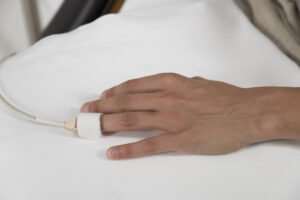
Detection via a finger sensor
It is possible to measure the interval between heartbeats with a Finger sensor to record the heartbeat. This uses pulse oximetry to record and visualise the heartbeat.
While this method is very suitable for applications in which the pulse is used as an indicator of general stress, the measurement accuracy is not sufficient for professional HRV training and especially for HRV diagnostics.
Nevertheless, this method can be used to explain the basic principle of HRV to clients and to carry out simple HRV training. For more precise recording, a high-resolution ECG sensor is used, the data from which is then analysed in special HRV software.
Recording via an ECG sensor
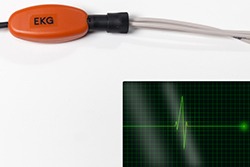
The so-called ideal way to record heart rate variability (HRV) is by means of an electrocardiogram (ECG). With the Neuromaster system, this is done with the ECG sensor carried out.
This sensor detects the heartbeat much more precisely than a finger sensor or a simple heart rate monitor, for example.
However, not every ECG system can record HRV in a quality that is suitable for professional HRV diagnostics. A sufficient sampling rate, i.e. high recording accuracy, is crucial. In order to reliably record HRV, the sampling rate should be above 1000 Hertz.
In practice, carrying out the measurement is straightforward, as there are usually clear instructions on how to place the electrodes. For example, you will find detailed information on this in the Biolife training manual.
Respiratory sinus arrhythmia - heartbeat and breathing
The function of the body that best reflects the adaptability of the heart is the so-called Respiratory sinus arrhythmia (RSA). This complex-sounding term describes the synchronised relationship between breathing and heartbeat. If you have ever been connected to a hospital ECG with an acoustic signal, you may have noticed that the „beep“ sound speeds up when you breathe in and slows down when you breathe out. This is exactly what the RSA is all about.
The synchronisation of the heart rate with the breathing rhythm has proven to be an ideal parameter for assessing HRV. Studies have shown that the RSA increases with positive emotions such as love or gratitude, while this synchronisation disappears with stress, anger and fear.
Breathing biofeedback is therefore used to improve HRV through relaxed breathing. In addition, clients can learn to harmonise these two values through the simultaneous feedback of breathing and heart rate.
Examples of HRV biofeedback applications
Working with HRV has shown impressive success with many disorders, some of which are listed below as examples.
Conclusion on the study situation
Work with HRV is therefore based on solid, evidence-based foundations. The wide range of applications is probably due to the fact that Biofeedback is generally a very versatile method and, on the other hand, because HRV is such a fundamental parameter for the health and resilience of the organism.
Stress, depression and anxiety
Studies have shown a reduction in symptoms of stress, anxiety and depression after 4-5 weeks12.
Another study from Germany found that after treatment with HRV biofeedback, test subjects not only showed lower depression levels, but also improved heart rate variability, reduced anxiety and a lower heart rate.3
High blood pressure
A study using HRV biofeedback showed an improvement in baroreflex, autonomic function and a reduction in blood pressure4.
Competitive sport
Workplace health promotion
Sources:
- Purwandini Sutarto, A., Abdul Wahab, M. N., & Mat Zin, N. (2012). Resonant breathing biofeedback training for stress reduction among manufacturing operators. International Journal of Occupational Safety and Ergonomics, 18(4), 549-561.
- Ratanasiripong, P., Kaewboonchoo, O., Ratanasiripong, N., Hanklang, S., & Chumchai, P. (2015). Biofeedback Intervention for Stress, Anxiety, and Depression among Graduate Students in Public Health Nursing. Nursing research and practice, 2015.
- Siepmann, M., Aykac, V., Unterdörfer, J., Petrowski, K., & Mueck-Weymann, M. (2008). A pilot study on the effects of heart rate variability biofeedback in patients with depression and in healthy subjects. Applied psychophysiology and biofeedback, 33(4), 195-201.
- Lin, G., Xiang, Q., Fu, X., Wang, S., Wang, S., Chen, S., ... & Wang, T. (2012). Heart rate variability biofeedback decreases blood pressure in prehypertensive subjects by improving autonomic function and baroreflex. The Journal of Alternative and Complementary Medicine, 18(2), 143-152.
- Lagos, L., Vaschillo, E., Vaschillo, B., Lehrer, P., Bates, M., & Pandina, R. (2008). Heart rate variability biofeedback as a strategy for dealing with competitive anxiety: A case study. Biofeedback, 36(3), 109.
- Munafò, M., Patron, E., & Palomba, D. (2015). Improving Managers’ Psychophysical Well-Being: Effectiveness of Respiratory Sinus Arrhythmia Biofeedback. Applied psychophysiology and biofeedback, 1-11.
Interpretation of heart rate variability
As we have seen, the heart is not a pendulum that beats steadily, but is subject to natural fluctuations. These fluctuations contain important information for users. But how do we extract this information effectively?
Deriving the HRV from the ECG curve alone requires expertise and practice. Even an ECG that appears regular at first glance can be variable if you take a closer look at the RR intervals.
A first simple method of assessing HRV is to look at the breathing curve together with the heart beats per minute. If the breathing movements - inhalation (increase in the breathing curve) and exhalation (decrease in the breathing curve) - are in line with the increase and decrease in the heart rate, this is a positive sign.
HRV can be analysed more comprehensively using various HRV values and diagrams, which we will discuss briefly below.
Values
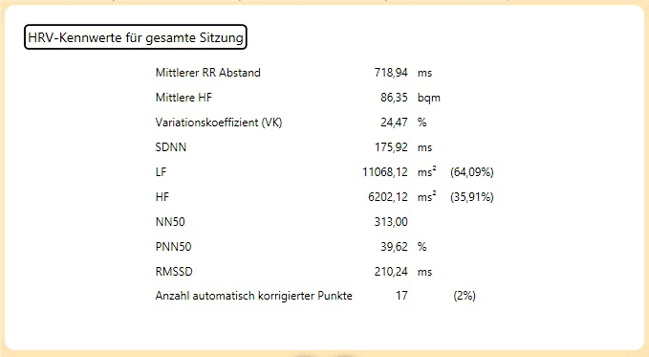
As part of the HRV analysis, you will repeatedly encounter various values. These values can be found, for example, in the output of the Biolife software to find. Below you will find some information on these values.
SDNN
The SDNN (standard deviation of all RR intervals) describes the variance of the heart rate over the entire recording period. A high SDNN indicates a pronounced heart rate variability.
It is important to note that the SDNN can only be interpreted meaningfully if the recording duration and activity conditions remain constant. Comparisons should therefore only be made within similar measurement conditions, as different factors can influence the values. In addition, the values for a „good“ or „average“ SDNN are age-dependent and can vary.
PNN50
PNN50 is the percentage of all RR intervals that differ from the previous interval by at least 50 milliseconds. High PNN50 values indicate greater long-term variability and increased parasympathetic activity. Compared to SDNN, PNN50 is more stable and less susceptible to short-term fluctuations.
VK (coefficient of variation)
The coefficient of variation is a very practical value in the evaluation of HRV. It is the standard deviation of the RR intervals in relation to the mean value. The greater the coefficient of variation, the higher the heart rate variability (HRV).
Further values
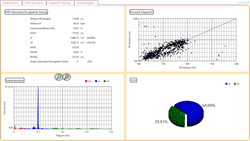
As you can see in the image, there are many other parameters in the HRV analysis, such as LF/HF and the Poincaré diagram. However, the discussion here would go a little beyond the scope. However, a detailed discussion of these values would go beyond the scope. Don't worry - the Biolife user manual offers comprehensive explanations of these values and also contains standard tables.
Conclusion
As you can see, working with heart rate variability (HRV) and biofeedback is an exciting area of psychophysiology. A major advantage of biofeedback compared to simple measuring devices is that it not only records HRV, but can also be used for direct training.
Without exaggeration, HRV biofeedback can be described as one of the current superstars in the field of biofeedback. Numerous studies confirm the effectiveness of this method for various disorders. We are convinced that this trend will continue, which is one of the reasons why the Neuromaster system has been equipped with an ECG sensor.
The method is also very popular with users. Despite the seemingly complex subject matter, it is relatively easy to get started with the method and clients usually understand the concept quickly. A short HRV training course can provide helpful support here.
For further information and sources, we recommend the basic work by Dr Doris Eller-Berndl: Eller-Berndl, D. (2010). Heart rate variability. Verlag-Haus d. Ärzte.
This book is particularly recommended to anyone interested in HRV diagnostics.