


What advantages can Biofeedback in the treatment of Incontinence compared to traditional pelvic floor training? In an exclusive interview, we discussed this with the experienced biofeedback trainer Dr Lisa Maria Glenk spoken:
Question: How effective would you rate biofeedback in the treatment of incontinence, and what added value do you see compared to traditional pelvic floor training, which is also effective?
Answer: Absolutely, I really see the use of biofeedback here as a synergy. Biofeedback and conventional pelvic floor training go well together, go hand in hand and are ideally used in combination.
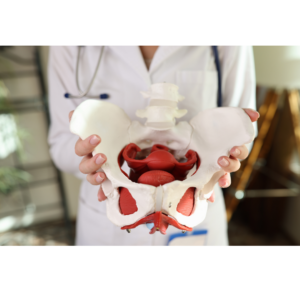
The great added value of biofeedback is that visual feedback makes it easier to localise the pelvic floor. There are many women who tend to tense the abdomen or the gluteus maximus, i.e. the gluteus maximus, rather than the pelvic floor during gymnastics. By using an electrode probe, it is possible to derive the activity directly from the relevant muscle layers and to check whether the women are really only tensing there. This means that the tensing takes place in the right place and not through auxiliary and supporting muscles. This means that they are in exactly the right place and do not run the risk of tensing the wrong muscles. Another advantage is the immediate feedback. It gives an immediate indication of whether the contraction is being performed correctly and how strong it is. The method quickly shows where something is happening.
Question: This means that EMG probes to record the muscle tension in the vaginal or rectal area. Do you also use other biofeedback parameters in practice?
Answer: Yes, absolutely. The most common probe I use is actually the vaginal probe for women. For incontinence symptoms in men, I use the probe available for men.
For me, it is important to take breathing into account as a guide during biofeedback training of the pelvic floor. The training is instructed in such a way that the contraction takes place at the appropriate moment in the breathing cycle, which is more effective and sensible for muscle training. This also avoids breathing pauses, which are not useful for pelvic floor training. At the same time, you can observe whether there is stagnation during inhalation or exhalation and whether the person is able to maintain a continuous flow of breath during the measurement. This is important in terms of your own energy management and promotes a better balance between the sympathetic and parasympathetic nervous system during the pause sequences.
Question: What are the practical reports from clients you have worked with? What are the short-term improvements that are reported here and how sustainable is the training effect once a training cycle has been completed?
Answer: With incontinence in particular, it is often the case that hardly any contraction strength can be seen in the biofeedback leads at the beginning. The first step is to localise the muscles, which can be prepared well with some perception exercises. The biofeedback signal often shows that the contraction strength is reduced, and then you work on increasing the contraction strength and healthy muscle tone again. This usually works relatively quickly, especially if the person also practises a little at home. The probe belongs to them and it can be helpful to use it at home for the first week or two in order to develop a feeling for the contraction and to increase it. The visual feedback reinforces the conviction that they can make a difference themselves. When those affected see that their peak values are getting higher and they can maintain a plateau, this is very reinforcing in terms of learning theory.
The training normally lasts several weeks. In a healthy woman who has developed pelvic floor weakness as a result of childbirth and pregnancy, significant relief of symptoms can often be achieved after just 8 to 10 sessions and even freedom from symptoms. For women who have suffered nerve and muscle damage following urological or gynaecological surgery, it often takes longer, up to three months or six months. However, the successes and scientific evidence for pelvic biofeedback are very encouraging and show that it is a useful, complementary method.



0 Comments