


Biofeedback is an innovative method that helps people to consciously control bodily functions – from relaxation to pain relief. However, How exactly does biofeedback work? In this article, we explain the process step by step and show how this technique can help you or your patients.
What is biofeedback?
Biofeedback is a non-invasive procedure, which measures the body’s own processes – such as heart rate, muscle tension and skin temperature – and provides real-time feedback. The aim is to use visual or audible signals to Control over unconscious bodily functions to achieve.
Typical areas of application:
- Stress and Anxiety Management (More on biofeedback for stress)
- Chronic pain (e.g. Migraines, back pain)
- High blood pressure & cardiovascular diseases (More on biofeedback for high blood pressure)
- Rehabilitation following injuries (More on biofeedback in rehabilitation)
- Improved concentration (e.g. in ADHD)
How does biofeedback work? Step by step
1. Preparation & Sensor Fitting
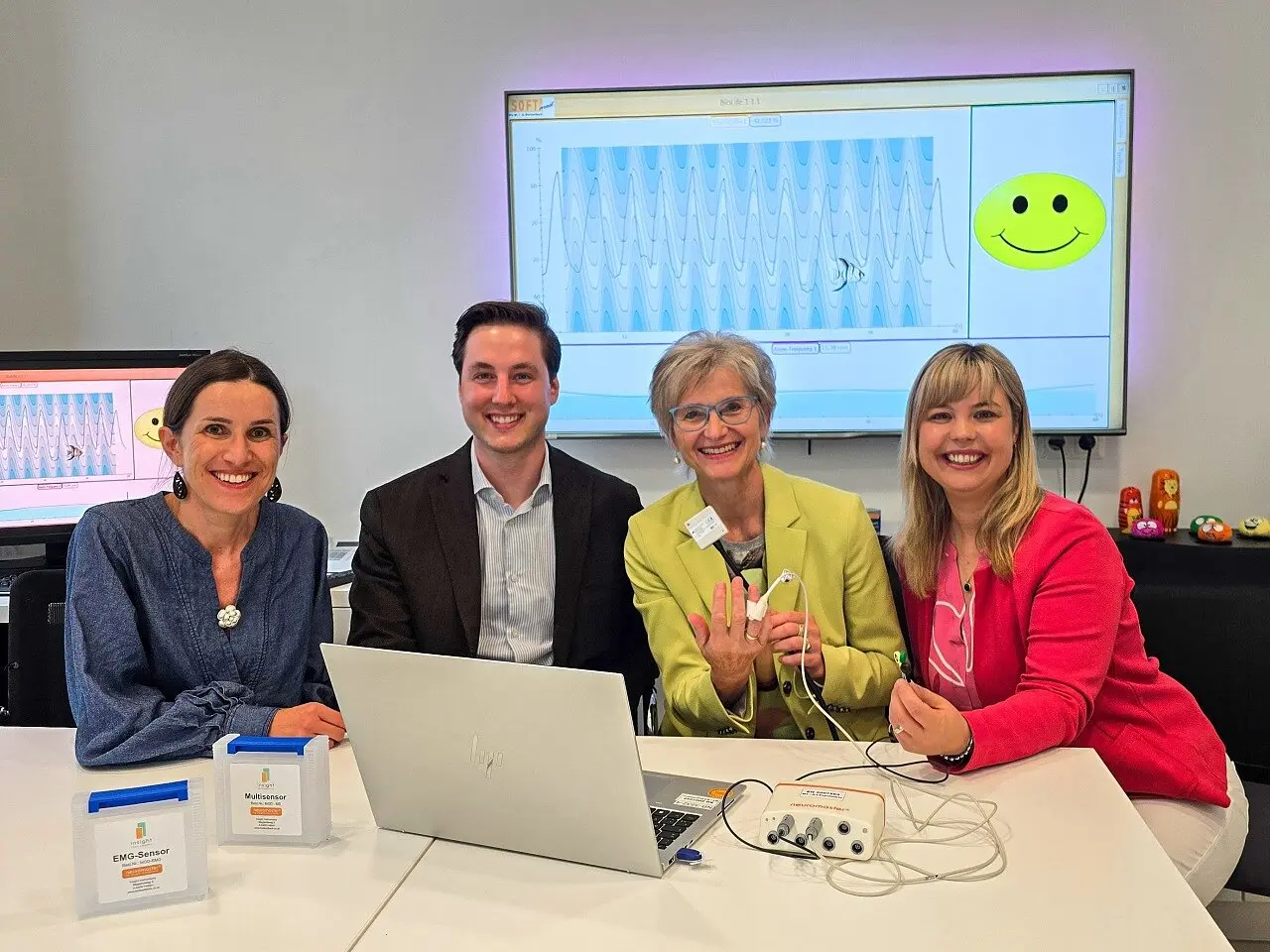
To begin with, Sensors attached to the body, which measure physiological signals. Depending on the objective, different sensors are used:
-
EMG (electromyography) – Measures muscle tension (e.g. in cases of muscle stiffness).
-
Breath sensor – Measures respiratory amplitude, respiratory rate and respiratory waveform.
-
Multisensor – Measures skin conductance (sweat gland activity during stress), pulse and temperature from a single finger.
-
Vaso-Sensor– Records the opening and closing of the temporal artery.
- HRV (heart rate variability) – Analyses stress levels via the heart rate.
-
EEG sensor (neurofeedback) – Measures the Delta, Theta, Alpha and Beta frequency bands and their ratios as part of frequency band training.
2. Real-time feedback on screen
The measured data is recorded in Real time on a screen depicted – often in the form of:
- Graphs (e.g. lines that become flatter when you relax)
- Games/Animations (e.g. a flower that opens when muscle tension decreases)
- Sounds (e.g. a signal that gets quieter as stress levels decrease)
3. Creating a stress profile: The diagnostic basis
Before each biofeedback session, there is a detailed psychophysiological stress analysis in accordance with standardised protocols for basic research. The resulting ‘stress profile’ provides crucial insights for further treatment planning:
- How does the patient’s body react to stress?
- How quickly can the patient calm down again?
- Which systems are particularly susceptible to stress?
4. Conscious training of bodily functions
Now the actual biofeedback training begins:
- By analysing the stress profile, any treatment can tailor-made be tailored to the physiological stress pattern in question.
-
The therapist or the software provides Instructions (e.g. „Take a deep breath and relax your shoulders“).
-
Through Trying out different techniques (Breathing exercises, visualisation, progressive muscle relaxation) help patients to influence their body’s signals.
-
Results are immediately visible, which boosts motivation.
5. Analyse progress & develop long-term strategies
After several meetings, it has become clear that:
- Which techniques are most effective (e.g. deep abdominal breathing versus meditation).
- Whether physiological parameters improve (e.g. a lower resting heart rate).
- How what you have learnt can be applied in everyday life.
- Whether comparing the results with the initial stress profile reveals any therapeutic benefits (e.g. reduced muscle tension following cognitive stressors)
Scientific principles: Why biofeedback works
Biofeedback is based on the principle of operant conditioning and is supported by numerous studies:
-
One Meta-analysis by the American Psychological Association has shown significant success in numerous indications
-
More than 700 hospitals and health centres are successfully using biofeedback and neurofeedback in their day-to-day clinical practice – You can find real-life case studies here.
How long does it take for biofeedback to take effect?
-
In the short term: Some effects (e.g. relaxation) can be felt straight away.
-
In the long term: For lasting change (e.g. in the case of chronic pain), the following are approx. 10–20 sessions recommended.
Conclusion: Biofeedback – Scientifically-based self-regulation
Biofeedback uses modern technology to To better understand and manage the body and mind. Whether you’re dealing with stress, pain or difficulty concentrating – this method offers a a natural, drug-free alternative.
Would you like to try biofeedback? Find a certified therapists in your area
Would you like to offer biofeedback in your practice? We’ll advise you on how to incorporate this into your day-to-day therapy practice and work with you to develop a bespoke biofeedback programme. Please select a suitable appointment time here.



0 Comments