


Biofeedback and neurofeedback for epilepsy
Epilepsy is caused by a combination of brain damage and a congenital predisposition to seizures. In theory, anyone can develop epilepsy, the main characteristic of the condition being the recurrent occurrence of seizures.
Neurofeedback in epilepsy
The history of the treatment of epilepsy with Neurofeedback It began with a chance discovery by the researcher Barry Sterman. Barry Sterman, a researcher, had manipulated the brainwaves of cats in a study. Independently of this study, in another study on the effects of rocket fuel, he found that those cats which had undergone this brainwave manipulation in Study 1 were much more resistant to epileptic seizures caused by this fuel. This phenomenon was later successfully applied to people with drug-resistant epilepsy.
Neurofeedback therapy makes use of what is known as SMR neurofeedback, which involves training the sensorimotor rhythm (SMR).
Placement of the electrodes and procedure
In SMR training for epilepsy, training is carried out at points C3 or C4 of the 10–20 system, and theta activity is reduced centrally at Fz. Up to two training sessions per week are carried out over a period of at least 20 weeks.
Effectiveness
SMR neurofeedback has been used in the treatment of epilepsy for more than 40 years, and a 2009 analysis concluded that EEG training led to a significant reduction in the frequency of seizures. This was all the more remarkable given that the clients were unable to control their seizures with medication.
A table from a research paper by Sterman (2000) showed that 82% of clients experienced a significant reduction in seizures. Approximately 5% were even completely seizure-free over the course of one year.
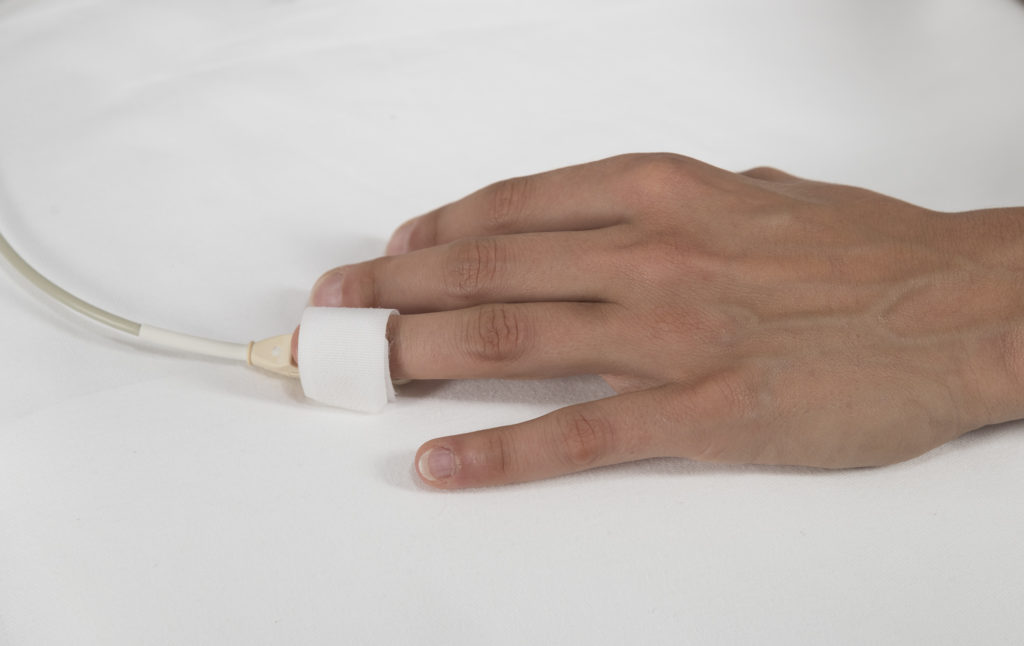
The skin conductance sensor is attached to the finger
Skin conductance biofeedback for epilepsy
It is not only neurofeedback – which is sometimes regarded as a more complex approach – that can be used in the treatment of epilepsy, but also the comparatively straightforward skin conductance training. The principle here is to monitor the psychophysiological arousal level via skin conductance. This can be utilised in training for epilepsy. The skin conductance sensor is, for example, simply attached to the finger.
Effectiveness
A study showed a significant reduction in the frequency of seizures, with an average reduction of 47.42%. In addition, levels of anxiety and depression improved in this study.
A review that examined the literature on skin conductance and epilepsy found that the studies included all showed a positive therapeutic effect. The difference in seizure frequency between the biofeedback group and the control group ranged from -54.4% to -74.0%4.
Conclusion
Both the SMR neurofeedback as well as the Skin Conductance Training are promising methods for treating epilepsy, particularly in patients who do not respond to medication. Whilst SMR neurofeedback is a tried-and-tested but more demanding method, skin conductance training offers a simple yet effective alternative. Both approaches deserve special attention, particularly given their effectiveness in treating drug-resistant epilepsy.
Biofeedback for:
ADHD
Anxiety disorders
Asthma
Profession
High blood pressure
Depression
Epilepsy
Erectile dysfunction
Incontinence
Competitive sport
Raynaud's disease
PTSD
Rehabilitation
Irritable bowel syndrome
Sleep disorders
Stress & burnout
Stress diagnostics
Pain therapy
Tinnitus
Constipation
Sources:
German Society for Epileptology (e.V.) – Epilepsy Information Centre, https://www.dgfe.org/
Egner, T. & Sterman, M. B. (2006). Neurofeedback treatment of epilepsy: from basic rationale to practical application. Expert Review of Neurotherapeutics, 6(2), 247–257. https://doi.org/10.1586/14737175.6.2.247
Haus, K., Held, C., Kowalski, A., Krombholz, A., Nowak, M., Schneider, E., Strauß, G. & Wiedemann, M. (2016). A Practical Guide to Biofeedback and Neurofeedback. In Springer eBooks. https://doi.org/10.1007/978-3-662-47748-9
Nagai, Y., Jones, C. I., & Sen, A. (2019). Galvanic skin response (GSR)/electrodermal/skin conductance biofeedback in epilepsy: a systematic review and meta-analysis. Frontiers in Neurology, 10, 377.
Tan, G., Thornby, J., Hammond, D. C., Strehl, U., Canady, B., Arnemann, K., & Kaiser, D. A. (2009). Meta-analysis of EEG biofeedback in the treatment of epilepsy. Clinical EEG and neuroscience, 40(3), 173-179.
Sterman, M. B. (2000). Basic concepts and clinical findings in the treatment of seizure disorders using EEG operant conditioning. Clinical electroencephalography, 31(1), 45-55.
Kotwas, I., Mcgonigal, A., Khalfa, S., Bastien-Toniazzo, M., Bartolomei, F. & Micoulaud-Franchi, J. (2018). A case-control study of skin conductance biofeedback on seizure frequency and emotion regulation in drug-resistant temporal lobe epilepsy. International Journal of Psychophysiology, 123, 103–110. https://doi.org/10.1016/j.ijpsycho.2017.10.005