


Chronic pain is one of the most common reasons for visiting a doctor or therapist. Yet despite medical assessment and, in many cases, successful pain diagnosis, the question remains: how can patients learn to actively manage their pain themselves? A key factor in this is the Self-efficacy – that is, the belief that one can influence pain through one’s own behaviour. This is precisely where biofeedback comes in.
What does self-efficacy mean in the context of pain?
Albert Bandura, who coined the term „self-efficacy“ in psychology, described it as ‘the belief in one’s own ability to successfully perform certain tasks’. For patients experiencing pain, this means having confidence in their ability to influence physical reactions and to modulate the intensity or perception of pain themselves.
Studies show that a high level of perceived self-efficacy in patients with chronic pain is associated with a better quality of life, lower levels of depression and a more active lifestyle. But how can this sense of self-efficacy be strengthened?
Biofeedback – an active learning method with demonstrable results
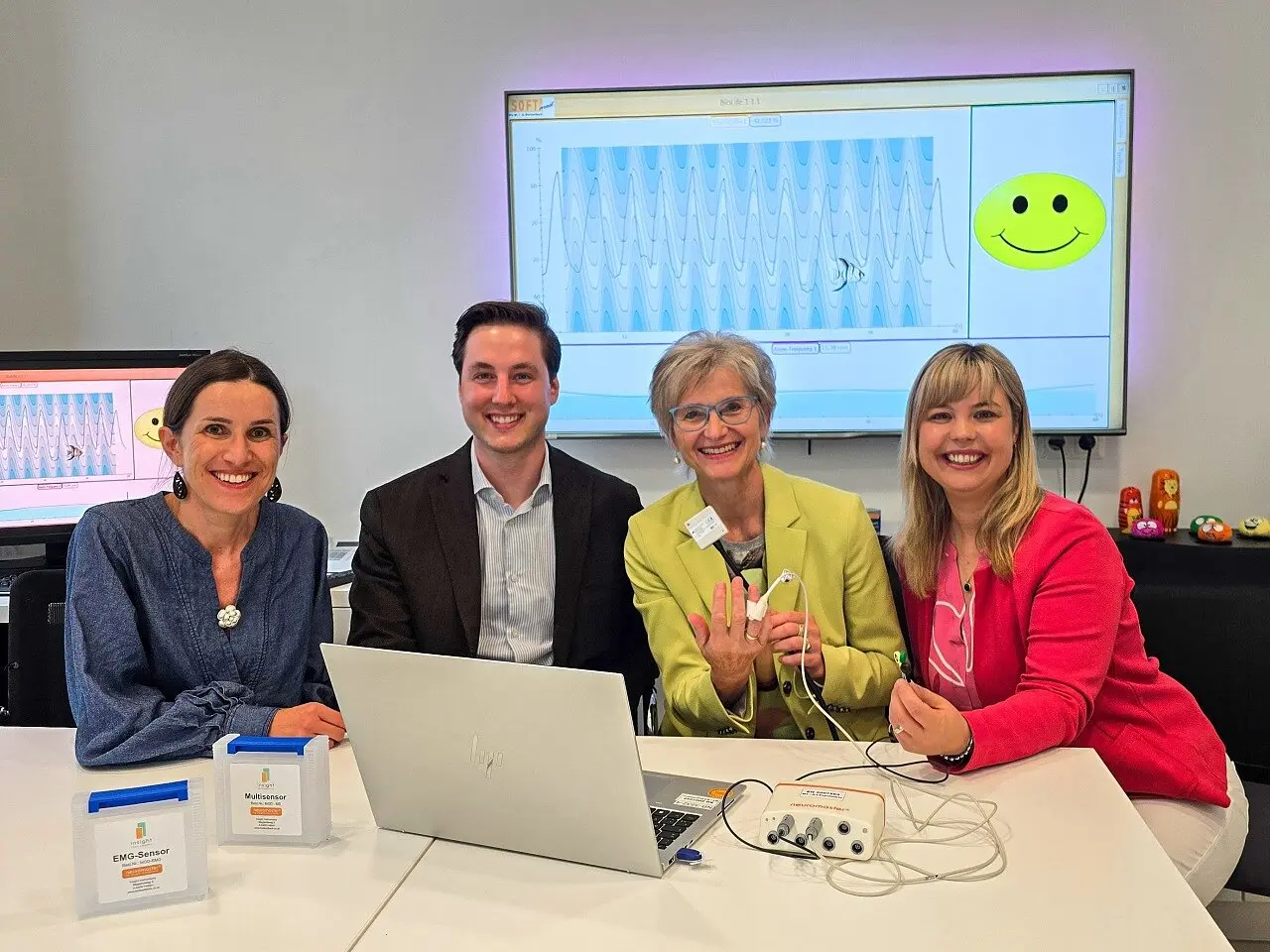
Biofeedback makes unconscious bodily processes visible and thus allows them to be specifically influenced. Sensors are used to measure physiological parameters such as muscle tension, skin conductance, heart rate and breathing, and display them on a screen in real time. The patient immediately realises that what they think, feel or do has an effect on their body.
This visual feedback is not only fascinating – it is also highly effective from a learning psychology perspective. After all, when people can see changes, they can practise them in a targeted way. Biofeedback thus acts as an interactive mirror of internal processes – and helps patients to learn functional regulation strategies.
Case study: Pain in the shoulder and neck area
A patient with chronic muscle tension in the neck area is being treated with EMG biofeedback. As early as the first session, she realises from the screen that simply thinking about an upcoming work meeting significantly increases her muscle tension. As a result, she learns to reduce the tension through targeted breathing exercises and mental focus – in a way that is visible, measurable and tangible.
After a few sessions, she reports that she is able to apply the techniques in her everyday life too: before meetings, when she is feeling stressed, or before going to sleep. The pain has not gone away – but her sense of helplessness has changed. That is precisely the key point: the patient has gained a greater sense of agency.
Biofeedback promotes neuroplasticity and lasting behavioural change
The brain is capable of learning – even when it comes to dealing with pain. Recent studies show that biofeedback training influences the neural link between stimulus and response. It not only enables short-term relaxation, but also the long-term reorganisation of response patterns. Profound changes can be achieved, particularly when combined with psychotherapeutic approaches such as cognitive behavioural therapy.
Which patients are suitable for biofeedback?
Biofeedback can be used to treat various pain syndromes, such as:
- Tension headaches
- Migraine
- chronic back pain
- musculoskeletal problems
- pain syndromes with a psychosomatic component
It is important to have a thorough diagnosis and an interdisciplinary approach. Biofeedback is not a substitute, but an effective complement to pain management.
Conclusion: From patient to active participant
Biofeedback helps patients move away from the passive role of simply enduring pain and discover new ways of coping. The realisation that they are no longer helplessly at the mercy of their pain, but can actively influence it, marks a crucial turning point in the therapeutic process.
For psychotherapists, doctors and psychologists, biofeedback offers an evidence-based, practical tool for helping patients experience a sense of self-efficacy – and thereby improve pain management in the long term.
Tip for your practice:
Our e-learning webinar, „Biofeedback Training for Pain Management“, provides you with a scientific and practical overview of how to use biofeedback effectively with patients suffering from chronic pain. Expand your knowledge now – Click here for the e-learning course.
Sources:
Didion, N., Kramp, A., & Karstens, S. (2023). The influence of self-efficacy on the daily management of pain in patients with musculoskeletal conditions. physioscience, 19(04), 170-179.
Calderone, A., Masi, V. M. M., De Luca, R., Gangemi, A., Bonanno, M., Floridia, D., … & Calabrò, R. S. (2025). The Impact of Biofeedback on Enhancing Chronic Pain Rehabilitation: A Systematic Review of Mechanisms and Outcomes. Heliyon.
Karasawa, Y., Yamada, K., Iseki, M., Yamaguchi, M., Murakami, Y., Tamagawa, T., … & Inada, E. (2019). Association between changes in self-efficacy and a reduction in disability among patients with chronic pain. PLoS ONE, 14(4), e0215404.
Nestoriuc, Y., Martin, A., Rief, W., & Andrasik, F. (2008). Biofeedback treatment for headache disorders: a comprehensive review of efficacy. Applied Psychophysiology and Biofeedback, 33, 125-140.
Sielski, R., Rief, W., & Glombiewski, J. A. (2017). The efficacy of biofeedback in chronic back pain: a meta-analysis. International Journal of Behavioural Medicine, 24, 25-41.



0 Comments