


Biofeedback in the treatment of Raynaud’s disease
Raynaud’s disease, also known colloquially as ‘white finger syndrome’, is characterised by numbness, pain and a sensation of cold in the fingers and toes. These symptoms can spread to the whole hand or foot and, in rare cases, may also affect the face. Women are five times more likely to be affected than men.
Treatment of Raynaud’s disease using biofeedback
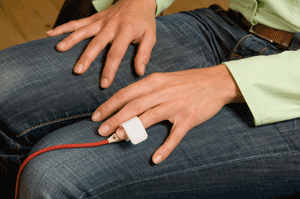 The main aim of the Biofeedback-Treatment In Raynaud’s disease, this involves learning to warm one’s hands at will (Khazan et al., 2023). This involves a Finger sensor used, which Temperature measures these and displays them on a screen. The feedback can be presented as a simple graph or in the form of animations and reward videos.
Animations, in particular, provide effective feedback: for example, patients can only progress along a set path if their hand temperature rises. Other relaxation techniques, such as breathing exercises, can also be used to complement this.
The training begins in a relaxed environment and is then continued whilst cold stimuli are applied (e.g. room temperature, cold objects) (Karavidas et al., 2006). The long-term effectiveness of the training is ensured through hand-warming exercises carried out at home without feedback, combined with a subjective assessment of the change in temperature.
It is possible for the training effect to be transferred to other limbs (e.g. the feet).
Effectiveness, tips and sources
According to an effectiveness review by the Association for Applied Psychophysiology and Biofeedback, the use of biofeedback for Raynaud’s disease was rated as „effective“, the second-highest level of effectiveness (Khazan et al., 2023). The long-term success rate is 70% (Ford, 1982).
Many therapists use temperature biofeedback to treat Raynaud’s disease. On average, the literature reports that 5–10 sessions are required; however, some individuals may need between 8 and 16 sessions (or more) to learn how to warm their hands (Karavidas et al., 2006).
The aim is to achieve a sustained reduction in the frequency and intensity of attacks, in order to significantly improve the quality of life of those affected. Studies have shown that temperature biofeedback brings about a greater reduction in the frequency of symptoms than EMG biofeedback or autogenic training (Freedman & Ianni, 1983; Freedman et al., 1988b). However, biofeedback can also be used to support other techniques, such as autogenic training.
Practical tips
The temperature in the hands can be significantly influenced by mental imagery. During biofeedback sessions, different images can be tried out to identify the most effective ones. For some patients, classic images of warmth (e.g. warm sand, fire, the sun, a radiator) work well, whilst for others, emotionally warm images (e.g. of loved ones or pets) or memories of positive events (e.g. holidays, professional success) are more effective.
Biofeedback for:
ADHD
Anxiety disorders
Asthma
Profession
High blood pressure
Depression
Epilepsy
Erectile dysfunction
Incontinence
Competitive sport
Raynaud's disease
PTSD
Rehabilitation
Irritable bowel syndrome
Sleep disorders
Stress & burnout
Stress diagnostics
Pain therapy
Tinnitus
Constipation
Sources:
Ford, M. R. (1982). Raynaud’s disease, essential hypertension, and irritable bowel syndrome: A review of the literature on long-term follow-up. Biofeedback and Self-regulation, 7(4), 521–536.
Freedman, R. R. & Ianni, P. (1983). The role of cold and emotional stress in Raynaud’s disease and scleroderma. British Medical Journal, 287(6404).